
The Weight We Carry
On Fathers, Forgiveness, and the Invisible Inheritance Passed from One Generation to the Next By Robert Fulton Buckholz

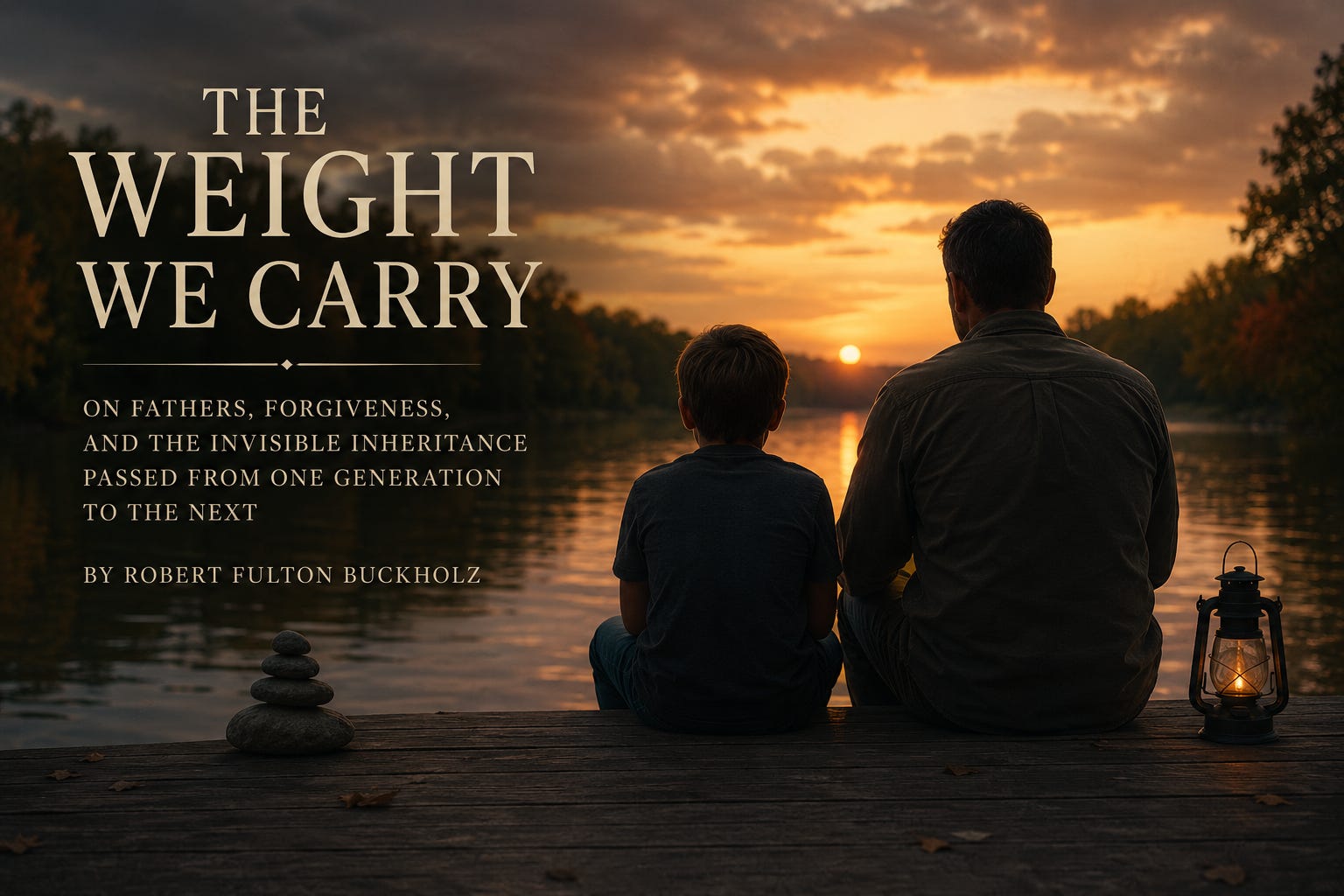
The Weight We Carry
On Fathers, Forgiveness, and the Invisible Inheritance Passed from One Generation to the Next
By Robert Fulton Buckholz
There is an invisible inheritance that arrives long before we understand we have received it. It is never mentioned in a will. It cannot be measured in dollars or weighed in the palm of a hand. It lives quietly beneath our thoughts, shaping the way we speak, the way we trust, the way we love, and even the way we retreat from love when it asks too much of us. We inherit more than our parents’ faces, their voices, or the familiar curve of a smile that unexpectedly appears in our own reflection. We inherit their unfinished stories. We inherit the victories they never celebrated, the grief they never spoke aloud, the fears they buried beneath responsibility, and the dreams they quietly surrendered somewhere between youth and survival. Long before we possess memories of our own, we are already carrying memories that were never ours.
As children we believe our parents occupy a world untouched by uncertainty. They appear larger than life because they are the first horizon we ever know. Their hands steady us before we learn to walk. Their words become the earliest architecture of our inner voice. Their approval teaches us confidence. Their disappointment teaches us shame. Every embrace becomes a lesson about belonging, and every silence becomes its own language. We do not recognize these moments as education because they are woven so naturally into childhood that they seem inseparable from existence itself. Only much later do we discover that we were never simply growing up. We were absorbing an entire emotional vocabulary that would one day become the lens through which we interpreted the world.
Time possesses a remarkable way of dismantling certainty. The people we once believed possessed every answer slowly reveal themselves to have been asking many of the same questions we ask today. The father who seemed impossibly strong was carrying fears he never allowed anyone to witness. The mother who appeared endlessly patient was often exhausted beyond words. The adults we once imagined stood firmly upon solid ground were, in truth, improvising each day with the same mixture of hope, doubt, courage, and vulnerability that accompanies every human life. Growing older is not simply the process of aging. It is the gradual realization that our parents were never mythical figures standing above humanity. They were humanity itself, clothed in ordinary lives, attempting to raise children while simultaneously trying to understand themselves.
This realization changes everything. It does not erase painful memories, nor does it excuse wounds that should never have been inflicted. Some childhoods are marked by tenderness. Others by absence. Many by both. There are fathers who loved deeply but could never find the language to express that love. There are fathers whose own childhoods left them emotionally unequipped to offer what they themselves had never received. There are fathers who disappeared into work, addiction, anger, silence, or regret, not because they intended to become strangers to those who loved them, but because they never learned another way to survive. None of these truths erase responsibility. Yet they remind us that every generation receives burdens from the generation before it. Pain has an extraordinary ability to travel through families unnoticed until someone finally chooses to stop carrying it.
Perhaps this is why forgiveness remains among the most misunderstood words in the human language. We often imagine forgiveness as a declaration that the past no longer matters, as though compassion requires amnesia. Yet memory does not disappear simply because we decide to move forward. The past continues existing exactly as it occurred. What forgiveness changes is not history but ownership. It asks us whether we intend to spend the remainder of our lives allowing yesterday to determine who we become tomorrow. It asks whether suffering must always possess the final word or whether, somewhere within the quiet strength of the human spirit, another ending remains possible.
There is a question that has followed me for years, arriving not through philosophy or theology but through the closing moments of a remarkable story. It is a question so simple that it almost escapes notice, yet so profound that it continues echoing long after the credits have disappeared. What remains after we forgive our fathers? The older I become, the more I believe that this question extends far beyond fathers alone. It asks what remains after we release any burden that has quietly become part of our identity. If we have carried resentment for decades, who are we without it? If disappointment has become the language through which we explain our lives, what happens when that language no longer serves us? If anger has been our companion for so long that it feels indistinguishable from ourselves, what extraordinary freedom—and frightening uncertainty—might await us on the other side of letting it go?
The answer, I believe, is not emptiness. It is possibility. Forgiveness does not remove the past from our lives. It removes the past from the driver’s seat. It allows memory to remain without permitting memory to become destiny. There is tremendous courage in making that decision because resentment often feels safer than hope. Anger is predictable. We know its voice. We understand its habits. Hope asks considerably more of us. Hope requires imagination. It asks us to believe that tomorrow need not become a repetition of yesterday. It invites us to become authors rather than archivists of our own lives.
Every generation eventually faces the same quiet choice. We may continue carrying every fear, every silence, every wound handed to us by history, or we may become the place where history gently changes direction. Perhaps this is the greatest responsibility of being human. Not perfection. Not achievement. Simply becoming the person who decides that pain will travel no farther than this heart, this home, this lifetime. That decision rarely attracts applause. It seldom appears in history books. Yet countless futures are quietly transformed because somewhere, someone chose understanding over bitterness, compassion over revenge, and hope over inheritance.
In the end, I no longer believe the greatest legacy our parents leave us is contained within photographs, family names, treasured possessions, or stories told around holiday tables. Their greatest legacy is the question they unknowingly place into our hands: What will you do with everything you have been given? The answer to that question determines far more than our relationship with the past. It determines the future we create for everyone who follows us. We cannot choose the inheritance we receive, but we possess the extraordinary privilege of choosing the inheritance we leave behind. Perhaps that is where forgiveness finally reveals its deepest purpose. It is not an act performed for those who wounded us. It is a gift offered to those we have not yet met. It is our quiet promise to the future that love will travel farther than pain, that understanding will outlive resentment, and that somewhere, because one ordinary human being found the courage to lay down an invisible burden, another child may grow up carrying a lighter heart than the one we inherited.
What struck me most is the distinction you make between inheritance and destiny. We don't choose what is handed to us, but we do choose what continues through us. That shifts responsibility from blame to stewardship, and I think that's where real healing begins. Thank you for writing something that invites reflection instead of offering easy answers.
Watching my own parents grow older and realizing they were basically just winging it the whole time was a massive shift for me. It makes it a lot easier to let go of old frustrations when you finally see them as ordinary people who were just exhausted and doing their best.