
The City That Cannot See Itself
Why the Greatest Threat to Modern Infrastructure May Not Be the Attack—But the Blindness That Follows

The City That Cannot See Itself
Why the Greatest Threat to Modern Infrastructure May Not Be the Attack—But the Blindness That Follows
By Robert Fulton Buckholz
There is a persistent misconception about cyberattacks that has been cultivated through decades of films, news headlines, and popular imagination. We picture an anonymous attacker somewhere across the world typing furiously as power grids collapse, water systems fail, and cities descend into immediate chaos. Reality is almost never so dramatic. Modern infrastructure rarely announces its distress with spectacle. Instead, it whispers. It begins with events so ordinary that no single department has any reason to suspect they are connected. A transformer unexpectedly trips offline. Water pressure falls slightly below normal in one district. A communications tower briefly loses connectivity. Traffic begins to back up at several intersections because a sequence of signals has defaulted to a safety mode. Emergency dispatch notices response times increasing by only a few minutes. Each event, viewed in isolation, is manageable. Together, however, they may represent the opening movements of a much larger story that no individual organization is capable of reading in its entirety.
This is the paradox of the modern city. We have spent decades making our infrastructure more intelligent, more efficient, and more interconnected, yet we continue to manage it as though it exists in separate and largely independent pieces. Water departments monitor water. Transportation agencies monitor traffic. Hospitals monitor healthcare. Utilities supervise electrical distribution. Emergency management coordinates first responders. Cybersecurity teams watch digital networks. Every organization performs its mission with professionalism, precision, and increasingly sophisticated technology. The problem is not that anyone is failing to do their job. The problem is that every organization sees only its own piece of a system that has quietly become inseparable from everything else.
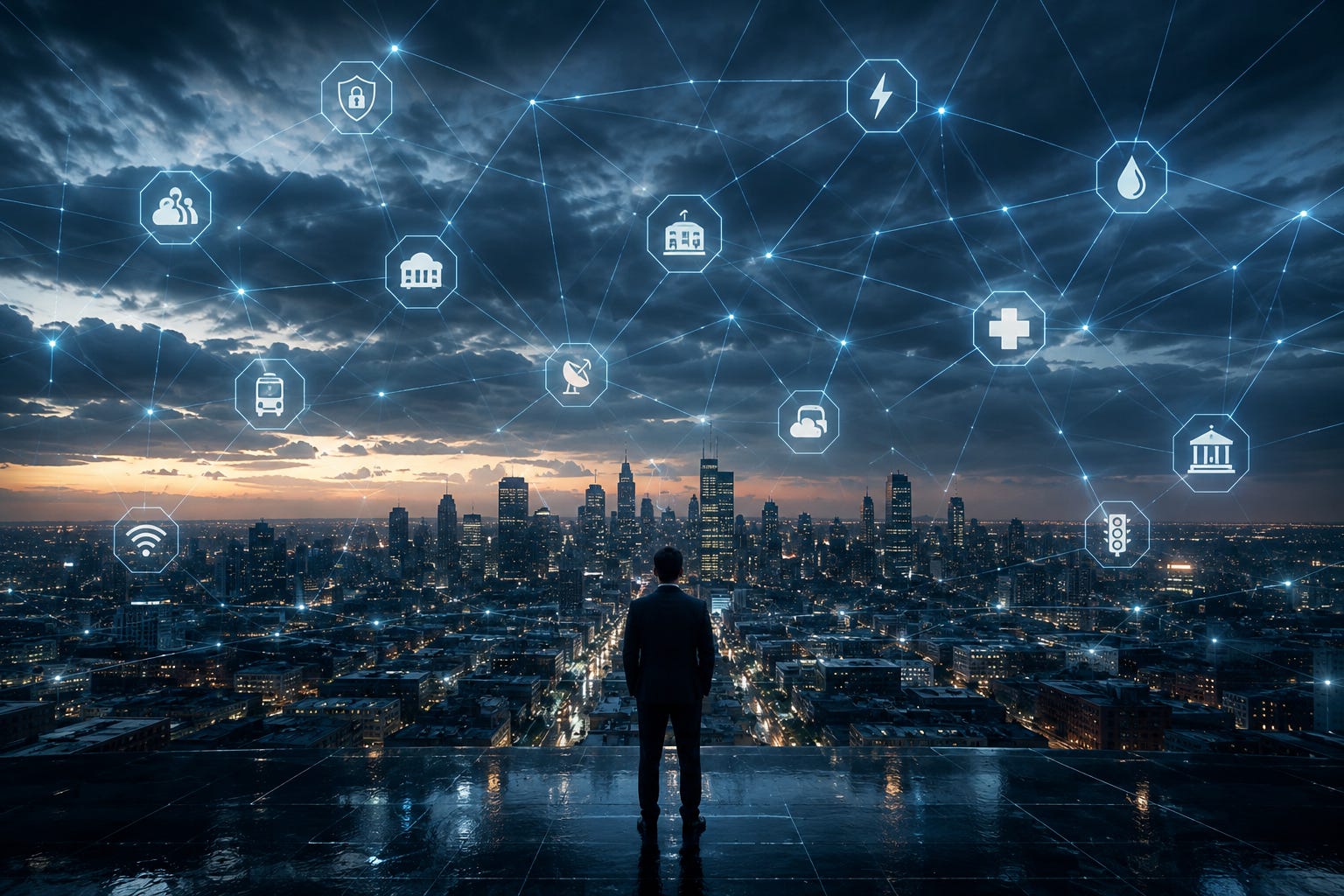
The modern municipality is no longer a collection of departments. It is a living network of relationships. Electricity powers water treatment facilities. Water pressure supports fire suppression. Communications coordinate emergency response. Transportation enables hospitals to receive patients and repair crews to restore damaged infrastructure. Cloud computing connects public administration to utilities, schools, public health agencies, and emergency services. What appears to be a series of independent systems is, in reality, a densely interconnected ecosystem whose behavior increasingly resembles that of a complex adaptive organism rather than a collection of isolated machines.
Complex systems fail differently than simple ones. A broken water main is a problem. A failed transformer is a problem. A cyber incident affecting municipal communications is a problem. Yet these events rarely remain confined to their point of origin. Modern infrastructure propagates disruption. A power interruption reduces pumping capacity at a water treatment facility. Declining water pressure begins affecting hospitals and fire suppression capabilities. Communications degrade as backup systems become overloaded. Traffic congestion slows repair crews attempting to restore damaged equipment. Emergency medical services begin encountering delays that were never anticipated by the original failure. By the time decision-makers recognize that these incidents are connected, the cascade has already begun. The first failure may never have been the real emergency. It simply became the catalyst for every vulnerability hidden within the relationships that followed.
Cybersecurity illustrates this challenge particularly well because it exposes a truth that extends far beyond malicious attacks. Public discussion often focuses on whether hackers can compromise a specific water treatment plant, electrical utility, or municipal network. Those questions are certainly important, but they are ultimately incomplete. The greater concern is not whether individual systems can be disrupted; it is whether the relationships between those systems can amplify disruption into something far more consequential than any single failure would have produced on its own. A cyberattack is only one possible initiating event. Severe weather, aging infrastructure, software failures, supply chain interruptions, equipment malfunction, or simple human error may produce remarkably similar patterns. Complexity does not distinguish between intentional and unintentional disruption. It merely responds to the relationships that already exist.
This realization suggests that we may be asking the wrong questions about the future of infrastructure. For years we have invested extraordinary effort into making individual systems smarter. Water systems have become more automated. Transportation networks increasingly rely on intelligent traffic management. Utilities deploy sophisticated monitoring platforms capable of analyzing thousands of operational variables simultaneously. Healthcare systems continuously optimize patient flow through advanced software. Each innovation represents genuine progress. Yet intelligence confined within organizational boundaries remains local intelligence. It improves the operation of individual departments while leaving the municipality itself without a coherent understanding of its own condition.
Imagine asking a physician to diagnose a patient after examining only the heart while another physician examines only the lungs, another only the kidneys, another only the nervous system, and none of them are permitted to speak with one another. Every specialist might reach an accurate conclusion regarding the organ under examination while completely missing the illness affecting the patient as a whole. Municipal infrastructure increasingly resembles this situation. Every department possesses expertise. Every department possesses data. Every department possesses increasingly capable technology. Yet the city itself has no equivalent of a nervous system capable of integrating those observations into a unified understanding of its own health.
The implications extend well beyond cybersecurity. Climate change is increasing the frequency and severity of extreme weather events. Infrastructure throughout much of the developed world continues to age while demands upon it steadily increase. Population growth places additional strain upon transportation, healthcare, utilities, and public safety. Municipal governments face growing expectations while operating within increasingly constrained budgets. At precisely the moment when cities require deeper situational awareness, the complexity of the systems they manage continues expanding faster than traditional organizational structures were ever designed to accommodate.
Perhaps the defining challenge of twenty-first-century infrastructure is no longer engineering alone. Perhaps it has become cognition. Our cities generate enormous quantities of information, yet information is not the same as understanding. Sensors can collect millions of measurements every hour. Dashboards can display thousands of operational variables simultaneously. Networks can transmit data instantaneously across entire continents. None of these capabilities guarantees that anyone truly understands what the city is experiencing as a living system. Knowledge remains fragmented, while complexity continues to grow.
This raises a question that deserves far more attention than it currently receives. Rather than asking whether artificial intelligence should replace municipal decision-makers, perhaps we should ask whether it can help municipalities understand themselves. The distinction is profound. One question concerns automation. The other concerns comprehension. The future may not belong to systems that make decisions instead of people, but to systems capable of revealing relationships that human organizations, by their very structure, struggle to perceive. Such technologies would not diminish human judgment. They would expand the context within which human judgment operates.
Whether this vision proves achievable remains an open scientific question. It demands research spanning artificial intelligence, systems engineering, emergency management, cybersecurity, public administration, infrastructure resilience, and the study of complex adaptive systems. What seems increasingly clear, however, is that our existing approach—treating each municipal function as though it exists independently—is becoming less adequate each year. The city has become something larger than the sum of its departments. It behaves as an interconnected organism whose resilience depends upon relationships rather than isolated components.
The next great infrastructure challenge may therefore have little to do with building stronger bridges, smarter pumps, or faster communication networks. It may instead require developing a new way of understanding the invisible relationships that bind those systems together. Before we ask whether our cities are becoming intelligent, we should first ask a far more important question: Can a city truly understand itself, or will it continue to rely upon fragmented observations until the next cascade teaches us, once again, that complexity always sees farther than we do?
— Robert Fulton Buckholz
S. Nebula Labs